
Introduction
This article shows examples on how to add different types of constraints into IPTIM plans. Using constraints you can estimate Annual Allowable Cut (AAC), account for market demand or resource limitations, and make sure plans are in line with certification and sustainability requirements.
Annual Allowable Cut (AAC) analysis
AAC indicates how much can be harvested from a given forest area, without compromising the long term sustainability. Typically the AAC is equal to average annual net growth rate.
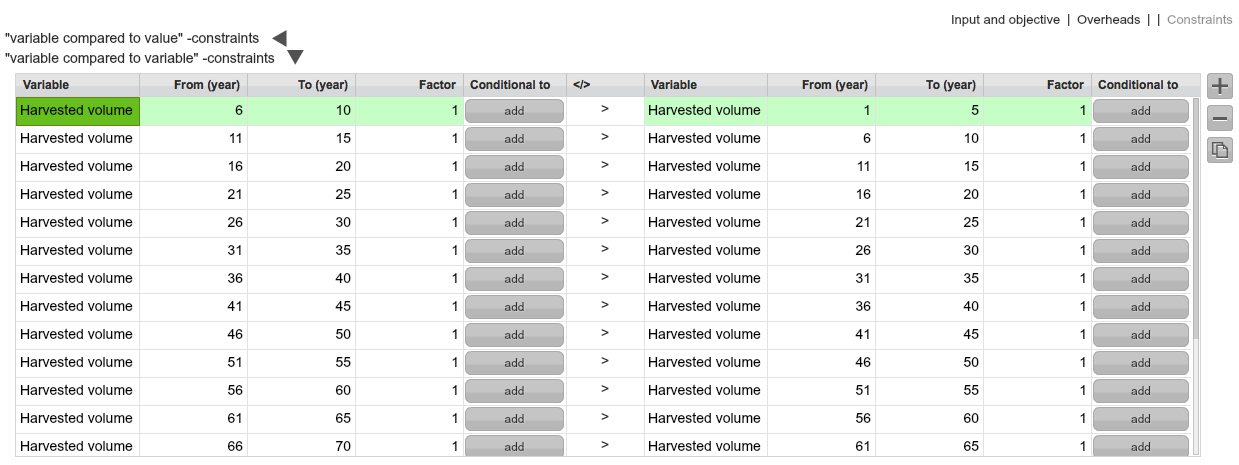
One approach for estimating AAC is to find the maximum harvest level that can be sustained over long term. Below is an example of constraints which ensure that the harvest level is non declining between each 5-year period during the next 100 years. As the average rotation is well below 100 years, these constraints give a reasonable estimate of the AAC.
Constraining clearcut areas
Constraining clearcuts to a maximum annual area is quite typical when you need to make sure forest legislation of certain countries, or forest management guidelines of your organisation. Below is an example how to limit the maximum clearcut area to 2 hectares on four consecutive 5-year periods. In other words, these constraints define that during the next 5 years you can clearcut maximum 2 hectares, and the same applies for the following 5 years.

Increasing standing stock
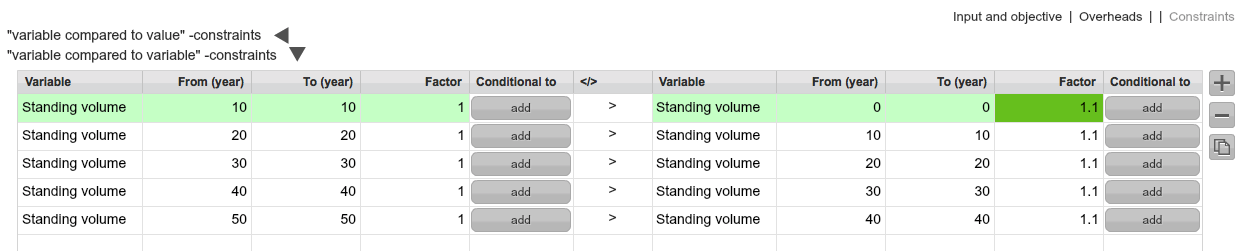
Sometimes due to certification criteria, or other objectives, the growing stock should be increasing rather than decreasing. This can also be accounted for using IPTIM's plan constraints. Below is an example of constraints that define that the standing stock volume should increase 5% on each 10-year period of the next 50 years.
Comments
0 comments
Please sign in to leave a comment.